Knebworth House
A Grade II* listed country house with listed gardens and parkland, also famous as the venue for the Knebworth rock festivals. It opens on selected dates, mainly between March and September, so check the calendar first.
Things to do
Historic buildings, abbeys, streets and monuments you can reach from LNER stations. 38 ideas in total.
A Grade II* listed country house with listed gardens and parkland, also famous as the venue for the Knebworth rock festivals. It opens on selected dates, mainly between March and September, so check the calendar first.
The site of a Bronze Age timber causeway and platform built about 3,500 years ago across the wet fen, with a reconstructed prehistoric landscape and preserved original timbers.
A Grade I listed country house built in the 1680s for Sir John Brownlow, set in formal gardens and a large wooded park. It is now looked after by the National Trust and has an outdoor playground for children.
A Grade I listed parish church whose spire is the second tallest in Lincolnshire. It is still an active church, so check service times before visiting.
The birthplace and family home of Sir Isaac Newton, complete with the orchard containing his famous apple tree and a hands-on Science Discovery Centre. National Trust.
One of the largest and finest parish churches in England, with parts dating from the twelfth century and a spire that is the tallest structure in the town. It remains an active parish church with a coffee house.
A memorial and visitor centre overlooking the city, with a 31-metre steel spire, walls of names and the interactive Chadwick Centre telling the story of RAF Bomber Command. Closed on Mondays except bank holidays.
An Italianate Victorian country house that has barely changed since the 1860s, making it one of the most complete of its kind in England. Run by English Heritage.
The Minster Church of St George was rebuilt to designs by George Gilbert Scott between 1854 and 1858 after fire destroyed the medieval church. Visitors are welcome on weekdays and Saturday mornings.
A Palladian house begun in 1733 on the site of a medieval priory, with landscaped gardens, parkland and a stables courtyard. National Trust.
A Grade I listed country house built between 1759 and 1771 to designs by John Carr and Robert Adam, set in a landscape by Capability Brown. It opens on set dates through the year, so check before travelling.
The atmospheric ruins of a Cistercian abbey founded around 1152, set in parkland beside the River Aire and painted by Turner among others.
Streets of workers' houses, public buildings and churches laid out in one harmonious style, preserved so completely that the whole village is a UNESCO World Heritage Site. It is free to wander.
One of Bradford's oldest buildings, with parts dating from the fourteenth century and a history that includes a spell as a Royalist base in the Civil War. Now a museum, closed Mondays and Tuesdays.
A seventeenth-century manor house with intimate gardens on the edge of Keighley, cared for by the National Trust.
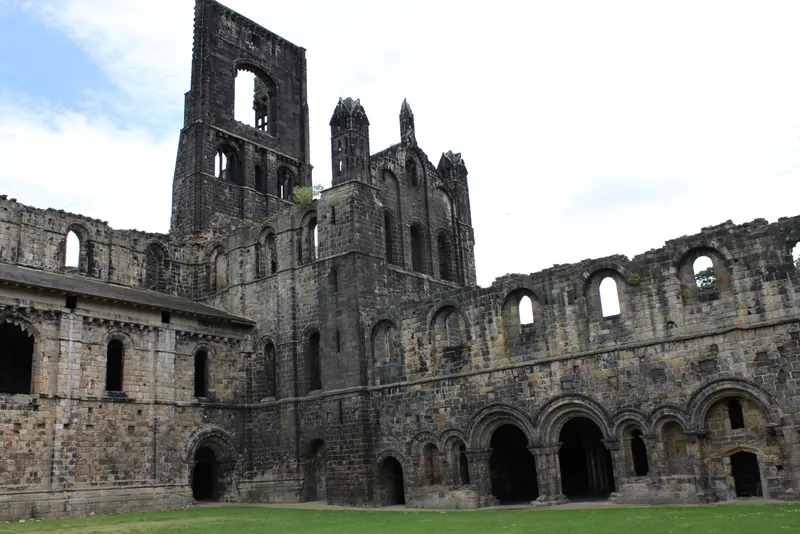
The ruins of a Cistercian abbey founded around 1152, in a public park beside the River Aire, with a museum in the old gatehouse area.
Grade II* listed Victorian Turkish baths, open since 1897, with Moorish arches and glazed brickwork. They run timed bathing sessions, including a eucalyptus-infused steam room.
A former Benedictine abbey church at the heart of the town since 1069, with free entry and a gift and coffee shop. Free guided tours of about 75 minutes run on set dates; donations are welcome.
A Georgian townhouse near Clifford's Tower, restored by York Civic Trust and furnished with the Noel Terry collection of furniture, clocks and decorative arts.
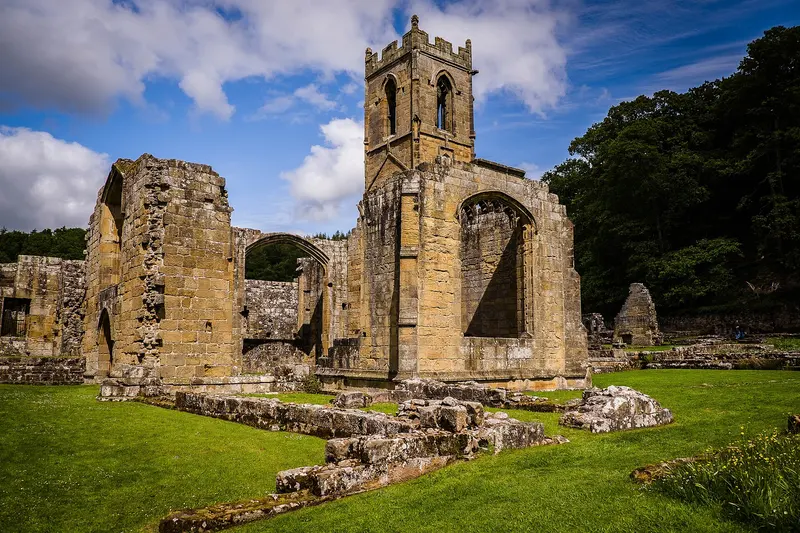
Founded in 1398, this was the last of the great Yorkshire monasteries and has the best-preserved ruins of any English charterhouse. The site also includes an Arts and Crafts house, terraced gardens and a café.
A country house with a walled garden, woodland and rolling estate, given to the National Trust in 1942. The house, garden and grounds keep separate hours.
The scant remains of a castle that was central to Anglo-Scottish warfare, and the later bastioned town walls that replaced it. Brown signs mark access points to the ramparts; some sections have steep unguarded drops.
The ruins of the priory on Holy Island, a cradle of early English Christianity, with its famous rainbow arch and a museum telling the island's story. Only reachable across the causeway at low tide.
The King's official residence in Scotland, at the foot of the Royal Mile, with the State Apartments, Mary, Queen of Scots' chambers and the ruined Holyrood Abbey. Open throughout the year.
The Victorian Gothic spire in Princes Street Gardens honouring Sir Walter Scott, one of the largest monuments to a writer anywhere. Guided tours explain Scott's life and the monument's history.
The former royal yacht, in service from 1954 to 1997, is now moored at Ocean Terminal in Leith and open to visitors, with lifts to each deck.
The remains of a large medieval Benedictine abbey beside a working parish church. The abbey is free to visit, though the palace ruins are currently closed.
Go aboard the Royal Research Ship Discovery, which was built in Dundee's shipyards and carried Captain Scott's Antarctic expedition, then explore the story of polar exploration in the visitor centre alongside.
Founded in 1178 and one of medieval Scotland's grandest monasteries, the abbey is famous for its twin-towered west front and its 'Round O' window. The visitor centre tells the story of the Declaration of Arbroath.
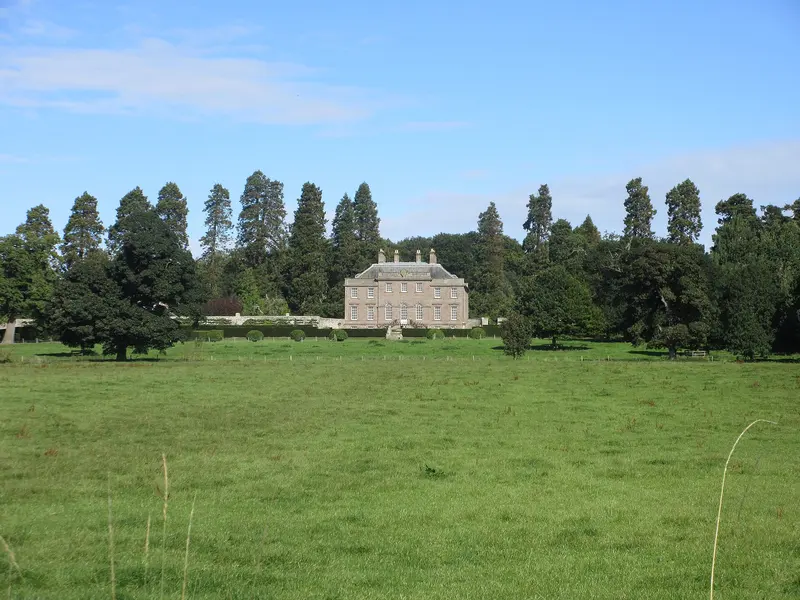
A Georgian house designed by William Adam and built in 1743, with fine plasterwork, formal gardens and woodland walks overlooking Montrose Basin. It is run by the National Trust for Scotland.
Dating from 1545, this is Aberdeen's oldest surviving townhouse, now a museum celebrating notable people from the city and the North-East. It opens seasonally, April to October, Thursday to Monday (2026).
A grand house in more than 170 acres of parkland that includes part of the Antonine Wall, a UNESCO World Heritage Site. House, exhibitions and Georgian kitchen are free to visit; closed on Tuesdays (as of September 2026).
The site of Robert the Bruce's victory in 1314, with a memorial park, restored monuments and Pilkington Jackson's bronze statue of Bruce. The visitor centre is closed for redevelopment until mid-2028, but the grounds and monuments stay open (as of September 2026).
A landmark tower on Abbey Craig telling the story of William Wallace, who led his troops to victory at the Battle of Stirling Bridge. Tickets are sold by timed entry slot.
The crowning place of Scottish kings, with state rooms, gardens, a pinetum and maze. Open daily from 1 April to 31 October in 2026.
Government barracks built in the early 1700s to police the Highlands. A Jacobite attack failed in 1745, but a stronger one forced its surrender the following year. Free to visit and open all year.
The arched stone bridge over the River Dulnain that gave the village its name is described as the oldest stone bridge in the Highlands.
Walk the moor where the 1745 Jacobite Rising ended in 1746, then visit the museum and 360-degree battle immersion theatre. National Trust for Scotland; the battlefield is open all year.
Nothing matches that region yet. Try another region or type.
Distances are approximate and measured from the station. Opening times, prices and booking rules change, so check the official website before you travel.
Check live times and fares with LNER, or compare prices on Trip.com. Book early for the best chance of a cheaper Advance fare.